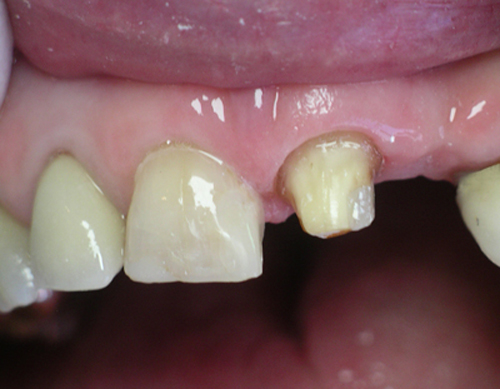
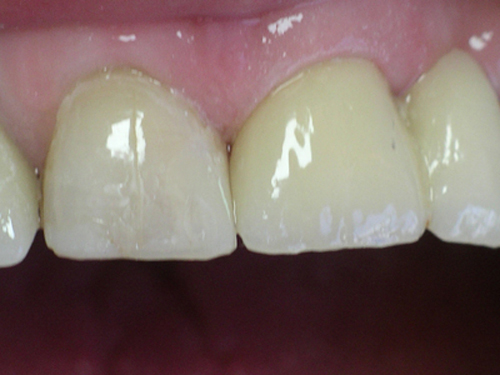
There is little that has a greater impact upon one’s personal appearance than the space created by the loss of a tooth. Furthermore, the teeth adjacent to the space can drift out of alignment and compromise the oral hygiene efficiency if left untreated. This can cause increased susceptibility to gum disease and may lead to tooth decay in these areas. There are 3 main ways of filling a gap- a denture, a bridge or an implant. Bridgework replaces a missing tooth, or teeth by attaching a replacement tooth onto the natural teeth at the end of the gap. For most people such an option is far more desirable than a partial denture.
There are two main types of bridgework – Adhesive and Conventional.
 This very conservative technique involves bonding a metal wing to the inner aspect of an adjacent tooth or teeth with special adhesives. The replacement tooth is held in place by this wing. The bonding procedure is very technique sensitive. Done well, in most cases towards the front of the mouth they are generally very reliable, for back teeth, the success rate is reduced. This type of bridge is sometimes used as a permanent solution, and also as a temporary answer during implant treatment.


 The natural teeth at each end are, in effect crowned, and the replacement tooth joins the crowns together into one large restoration. Sometimes, it is possible to be more conservative and to crown only one tooth and carry the replacement tooth as a cantilever. Conventional bridgework works very reliably for both back and front teeth providing the foundation teeth are in reasonable order. Bridges generally have a metal substructure, to provide strength, which is then covered with porcelain for optimal cosmetics. Nowadays, with modern technology it is possible to make fantastically aesthetic small bridges without any metal component by using a shade matched Zirconium core to provide the strength required. While large bridges are possible, they are not always advisable and nowadays, implants would probably be a better option to replace multiple teeth.