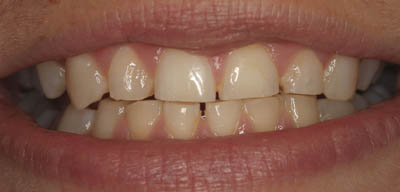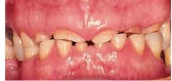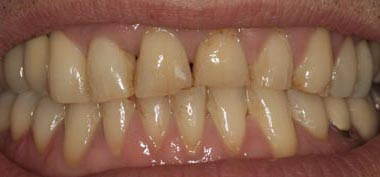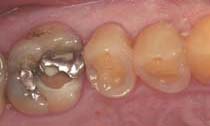
Tooth wear is an incredibly common occurrence that can happen even if someone looks after their teeth well. Dentists divide it into three main categories; attrition (tooth to tooth wear), abrasion (tooth to foreign body wear), erosion (chemically induced wear), and also abfraction (fractured enamel crystals near the gum edge caused by flexure of the teeth as they slide over each other).
All types can cause the loss of tooth enamel, exposing the underlying dentine and causing sensitivity of the teeth to temperatures, acidity and sometimes touch. Such sensitivity is most easily controlled with the use of desensitising toothpastes. These are best applied topically by rubbing them on to the affected area with a finger after brushing as normal with your regular toothpaste. Some pastes seem to be more effective for some patients than others so it is often a case of trying a few to see which works best for you. At the time writing this, we normally suggest trying either one of the various Sensodyne options eg Sensodyne Rapid Relief or Colgate Sensitive ProRelief, or there is a mouthwash, Listerine Advanced Defence Sensitive, which claims to be effective. There are also varnishes and resins that the dentist is able to professionally apply to aid relieve any symptoms. These pastes however do nothing to deal with the cause, which, if ongoing, will lead to further tooth surface loss.
Erosion is considered the most common cause of tooth wear. It is caused by acids either consumed within the diet, or otherwise by gastric reflux or eating disorders. Examples of food/drink commonly causing erosion are: citrus fruits, fruit juices, some fruit teas, wine, fizzy drinks (including lager and sports energy drinks). Tooth enamel starts to dissolve at pH 5.5, so the presence of acidic substances will easily cause softening and enamel loss to occur. If one brushes ones’ teeth after taking in acids then the brush will abrade away the already softened enamel (an interaction of erosion and abrasion). For those who like their orange juice at breakfast, it is better to brush before breakfast than after.
Erosion if mild can be controlled conservatively by addressing the underlying cause and using high fluoride pastes to strengthen the enamel and make it more resistant to dissolving.
Restoration if necessary can be carried out with tooth coloured fillings (composite fillings or porcelain onlays) to make good the defects.
Abrasion is also an incredibly common occurrence. It is commonly caused by excess brushing with an abrasive toothpaste, presenting as V shaped notches close to the gumline, though some dentists attribute this occurrence to abfraction. Ironically, there is some suggestion that soft brushes will cause more abrasion than hard brushes as the bristles splay out more and rub more paste against the tooth. We almost always advise using medium texture brushes. Occasionally abrasion can be caused by habits such as chewing a pen/pencil, hairclip or smoking a pipe, producing characteristic object shaped defects.
Abrasion defects on the side of the tooth can be left alone if shallow and asymptomatic, otherwise they can be filled with tooth coloured fillings. Repairing defects caused by pens/hairclips etc can be easily done with tooth coloured fillings but may be prone to breakage unless the habit is stopped. Porcelain may on occasions be used to provide a stronger restoration in severe cases.Treatment of wear cases may be for aesthetic (usually the patient’s request) or functional (usually the dentist’s suggestion) reasons. The case below is of wear caused by erosion (areas previously filled by white fillings, and a degree of attrition due to bruxism which has caused wear and chipping.
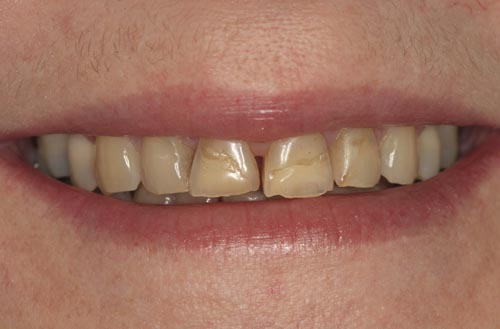
Attrition is another common occurrence and will occur to some extent through day to day use of our teeth. This is known as physiological wear. Some patients however have habits such as grinding (often at night, so most patients are unaware, unless told by their partner), known as bruxism or clenching the teeth. Since these acts are not part of normal function (chewing and swallowing) they are called parafunction. Our teeth should normally only meet together for a few minutes in every 24hrs, but if we are parafunctioning, this increases significantly, and teeth will wear or sometimes break. When wear is beyond that expected for the age of the patient it is known as pathological wear. Again, causes of wear often act together, if you drink wine late in the evening, this can soften the enamel so if you grind the teeth at night, they will more easily wear away.
Some people grind on their back teeth, some on their front, some towards one particular side, creating asymmetrical wear, so the presentation can be quite variable. From a health perspective, back and front teeth have a mutually protective function and for example, if the front teeth become worn down, the protection is lost and the back teeth become prone to breakage. As teeth wear, so they tend to move to close the space that has been created thus making restoration back to the original appearance more complex. Wear caused by grinding can be prevented by using a nightguard.
For a patient who grinds on the front teeth, as many people do, and leaves the rear teeth in good order it is often possible to rebuild the front teeth is a conservative way by opening the bite and allowing the rear teeth to erupt to regain contact. This is known as the Dahl technique.
In cases where wear involves both upper and lower teeth, back and front, full mouth rebuilding (rehabilitation) may be necessary.
We are located in the heart of Sevenoaks on the first floor of a wonderful Grade II listed building, originally built in 1818 as Lady Boswell School. We are delighted to say that we have our own dedicated lift.
1st Floor, Lady Boswell House, 42-44 London Road, Sevenoaks, Kent, TN13 1AS
Tel. 01732 459222 / Email us at admin@atkinsonbrignall.co.uk
Copyright © Atkinson Brignall Caring Dentistry • 1st Floor Lady Boswell House, 42-44 London Road, Sevenoaks, Kent, TN13 1AS